

How to Manage Peak Season Fulfilment
Peak season fulfilment can expose every weakness in a warehouse operation. Processes that work during normal trading can quickly break when order volumes increase, carrier deadlines tighten, stock moves faster, and customer expectations rise.
Whether the peak is Black Friday, Christmas, seasonal demand, promotional activity, or a major wholesale order cycle, operations teams need a clear fulfilment plan before pressure builds.
This guide explains how to manage peak season fulfilment, reduce operational chaos, protect service levels, and recover quickly when backlogs appear.
What is Peak Season Fulfilment?
Peak season fulfilment refers to the planning and execution of order fulfilment during periods of unusually high demand.
This usually involves higher order volumes, more warehouse activity, tighter carrier cut-offs, increased returns, temporary labour, and greater pressure on inventory accuracy.
Peak season fulfilment is not just about working harder. It is about designing the operation so the team can handle higher volumes without losing control.
For a broader explanation of fulfilment operations, read: What is Fulfilment Operations?
Why Peak Season Fulfilment Fails
Peak season problems are rarely caused by one single issue. They usually happen when several small weaknesses compound at the same time.
- Stock data is inaccurate
- Pick routes are inefficient
- Temporary staff are not trained properly
- Carrier cut-offs are missed
- Orders are not prioritised clearly
- Backlogs are not visible early enough
- Returns processes are underprepared
- Manual workarounds become overloaded
The goal is to identify these risks before peak trading starts.
1. Forecast Demand Early
Peak season planning should start with a realistic demand forecast.
Review:
- Previous peak season order volumes
- Promotional plans
- Marketing campaigns
- Channel-level forecasts
- Wholesale or B2B order cycles
- Supplier lead times
- Carrier capacity limits
Forecasting does not need to be perfect, but it should give operations teams enough visibility to plan stock, labour, warehouse space, packaging, and carrier capacity.
2. Protect Inventory Accuracy Before Peak
Peak season is not the time to discover that stock records are unreliable.
Before demand increases, operations teams should review inventory accuracy, problem SKUs, fast-moving products, and stock locations.
Important actions include:
- Cycle count high-volume and high-value SKUs
- Review products with recent stock adjustments
- Check fast-moving pick locations
- Separate damaged, returned, or quarantined stock
- Confirm stock availability across sales channels
- Review replenishment and purchasing plans
Related guides:
3. Simplify Warehouse Layout and Pick Faces
During peak season, walking time and product confusion can become major bottlenecks.
Before peak begins, review warehouse layout and pick-face setup.
- Move fast-moving products closer to packing areas
- Separate similar-looking products
- Ensure bin labels are clear and visible
- Increase pick-face capacity for high-volume SKUs
- Remove unnecessary stock from active pick areas
- Create temporary peak locations where needed
Small layout changes can make a significant difference when order volume increases.
Related guide: How to Improve Warehouse Picking Accuracy
4. Define Order Priority Rules
Peak season fulfilment becomes chaotic when every order feels equally urgent.
Clear priority rules help teams decide what should be picked, packed, and dispatched first.
Priority rules may be based on:
- Carrier cut-off times
- Delivery promise
- Customer type
- Order channel
- Marketplace SLA
- Wholesale dispatch window
- Stock availability
- High-value customers or VIP accounts
This is where order orchestration becomes important. Read: What is Order Orchestration?
5. Plan Labour Around Workload, Not Guesswork
Peak labour planning should be based on expected work, not simply on last year’s headcount.
Review:
- Expected orders per day
- Average order lines
- Picking productivity
- Packing productivity
- Carrier cut-off windows
- Inbound goods workload
- Returns workload
- Temporary staff productivity
Temporary staff can help, but only when processes are simple, documented, and controlled. Do not place untrained temporary workers into complex exception workflows without supervision.
6. Create Separate Workflows for Simple and Complex Orders
Not all orders should flow through the warehouse in the same way.
During peak, it can be useful to separate orders by complexity.
| Order Type | Suggested Approach |
|---|---|
| Single-item orders | Fast-track picking and packing |
| Multi-line orders | Use controlled picking and packing checks |
| High-value orders | Add additional verification |
| Marketplace orders | Prioritise SLA-critical dispatch |
| Wholesale orders | Plan separately due to volume and complexity |
| Back orders | Hold, split, or route based on clear rules |
Separating workflows helps protect speed without sacrificing accuracy.
7. Agree Carrier Cut-Offs and Capacity Early
Carrier performance is critical during peak season.
Before peak starts, confirm:
- Daily collection times
- Final dispatch cut-offs
- Weekend collection options
- Peak surcharges
- Maximum daily parcel capacity
- Backup carrier options
- International shipping restrictions
- Tracking update expectations
Carrier failure can damage customer experience even when warehouse teams perform well.
8. Prepare Packaging and Consumables
Running out of packaging during peak can slow down the entire operation.
Review expected demand for:
- Boxes
- Mailers
- Labels
- Tape
- Void fill
- Pallet wrap
- Printer rolls
- Shipping documents
Also check printer capacity, scanner availability, packing benches, and workstations before peak activity increases.
9. Monitor Backlog Daily
Backlog is one of the clearest signs that the operation is under pressure.
Track backlog by:
- Order age
- Warehouse
- Sales channel
- Carrier service
- Priority level
- Reason code
- Stock availability
A backlog is easier to recover when it is visible early. Once backlog becomes several days old, customer service pressure and operational complexity increase quickly.
Backlog should be reviewed alongside other fulfilment KPIs.
10. Protect Accuracy During Peak
Peak season often creates pressure to prioritise speed over accuracy. That can be expensive.
Picking and packing errors create:
- Replacement shipments
- Returns
- Refunds
- Customer complaints
- Stock discrepancies
- Extra customer service workload
Maintain key accuracy controls during peak, including barcode scanning, packing checks, location validation, and exception reporting.
11. Plan for Returns Before They Arrive
Returns often increase after peak trading periods.
If returns are not planned properly, they can create a second operational backlog after dispatch pressure has passed.
Prepare for:
- Return reason capture
- Inspection workflows
- Restock decisions
- Damaged stock handling
- Refund processing
- Stock updates
- Customer communication
Returns should be treated as part of fulfilment operations, not an afterthought.
12. Communicate Clearly With Customers and Teams
Peak season fulfilment is not only an operational challenge. It is also a communication challenge.
Customers need clear expectations around delivery times, cut-off dates, delays, tracking, and returns.
Internal teams need visibility of:
- Daily order volume
- Dispatch targets
- Backlog position
- Carrier issues
- Stock risks
- Priority orders
- Operational exceptions
Good communication reduces uncertainty and helps teams act faster.
Peak Season Fulfilment Checklist
| Area | Action |
|---|---|
| Demand | Forecast order volume by channel and period |
| Stock | Cycle count key SKUs and check availability |
| Warehouse | Review layout, pick faces, and packing capacity |
| Labour | Plan shifts around workload and cut-offs |
| Carriers | Confirm collection times, capacity, and backup options |
| Systems | Test order flow, scanning, labels, and integrations |
| Backlog | Monitor daily by age, channel, and reason code |
| Returns | Prepare post-peak returns workflows |
How Technology Helps During Peak Season
Technology helps peak season fulfilment by giving teams better control, visibility, and automation.
A fulfilment platform can help with:
- Order prioritisation
- Warehouse task control
- Barcode scanning
- Inventory visibility
- Carrier integration
- Backlog monitoring
- Fulfilment KPI tracking
- Returns workflows
To understand how OMS and WMS systems work together, read: OMS vs WMS: What’s the Difference?
How Modulus365 Helps with Peak Season Fulfilment
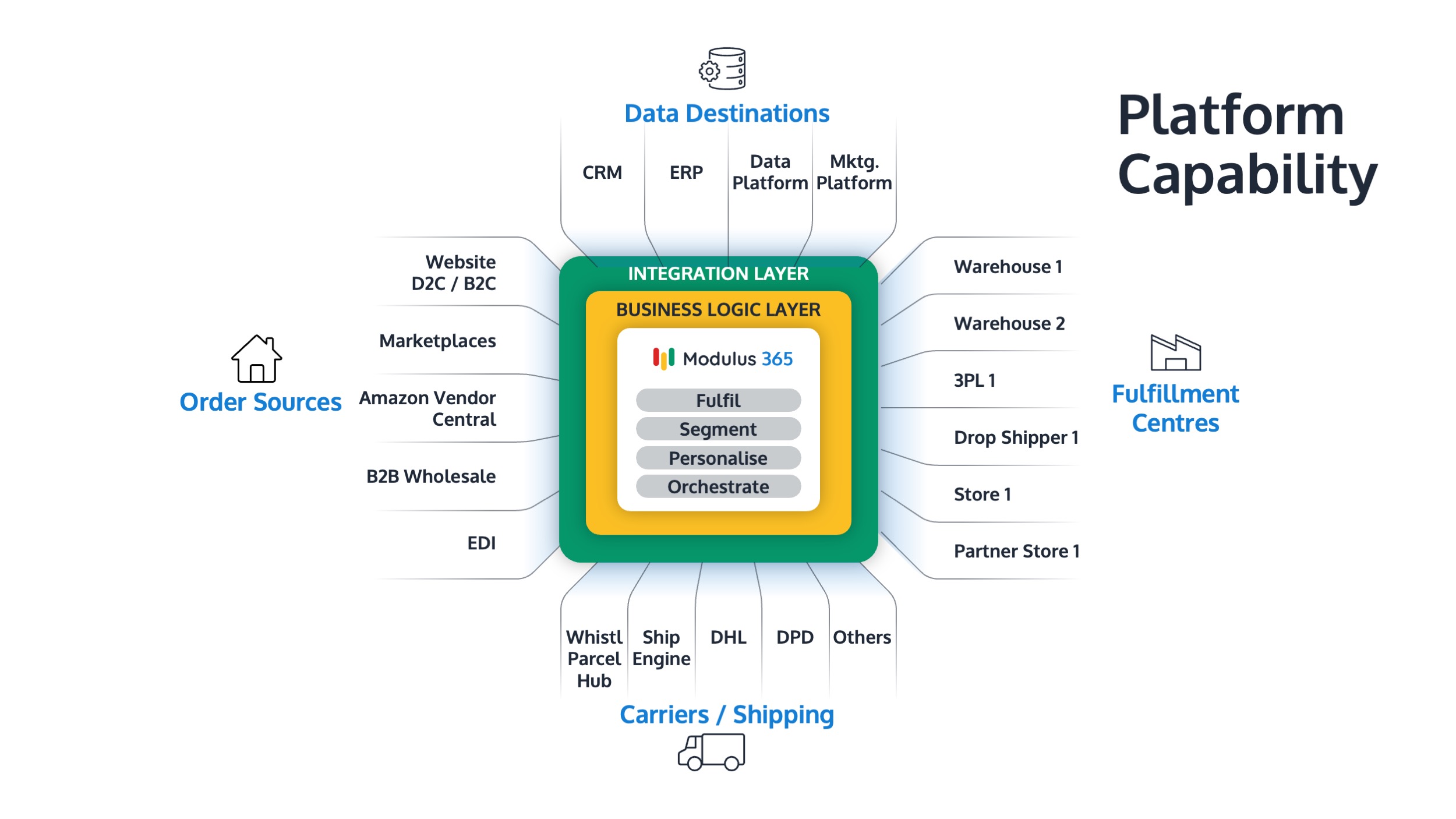
Modulus365 helps businesses manage peak fulfilment by connecting order orchestration, warehouse workflows, inventory visibility, carrier integrations, and operational reporting.
For Sage businesses, Modulus365 can work alongside the ERP as the fulfilment operations layer, helping teams scale order processing without relying on disconnected systems or manual workarounds.
👉 Learn more about Modulus365 for Sage.
Related FOA Guides
Peak season fulfilment depends on strong planning, stock accuracy, warehouse control, clear order rules, and returns preparation. These guides will help you strengthen each area:
- What is Fulfilment Operations?
- What is Order Orchestration?
- Fulfilment KPIs Every Operations Leader Should Track
- Inventory Accuracy: Why It Breaks and How to Fix It
- Cycle Counting vs Annual Stock Takes
- How to Improve Warehouse Picking Accuracy
- How to Reduce Fulfilment Cost Per Order
- Returns Management Best Practices
Ready to Prepare for Peak Fulfilment?
If peak season puts pressure on your warehouse, stock accuracy, order flow, carriers, or customer service teams, Modulus365 can help bring more control and visibility into fulfilment operations.
Frequently Asked Questions
What is peak season fulfilment?
Peak season fulfilment is the planning and execution of order fulfilment during periods of unusually high demand, such as Black Friday, Christmas, seasonal peaks, or major promotional periods.
How do you prepare a warehouse for peak season?
You can prepare by forecasting demand, checking stock accuracy, improving pick locations, planning labour, confirming carrier capacity, preparing packaging, and monitoring backlog daily.
What causes fulfilment problems during peak season?
Common causes include poor stock accuracy, inefficient picking, unclear order priorities, insufficient labour planning, carrier capacity issues, disconnected systems, and weak backlog visibility.
How can businesses reduce peak season backlog?
Businesses can reduce backlog by prioritising orders, separating simple and complex workflows, increasing picking and packing capacity, monitoring backlog by reason code, and improving order orchestration.
Why is inventory accuracy important during peak?
Inventory accuracy is critical during peak because poor stock data leads to failed picks, overselling, split shipments, delayed dispatch, and customer service issues.