

Carrier Selection Rules for Fulfilment Teams
Carrier selection is a critical part of fulfilment operations. Choosing the wrong carrier or delivery service can increase costs, delay orders, miss customer promises, and create avoidable customer service issues.
As order volumes grow, fulfilment teams need clear carrier selection rules so shipping decisions are consistent, cost-effective, and aligned with customer expectations.
This guide explains how carrier selection rules work, what factors to consider, and how fulfilment teams can improve delivery performance without relying on manual judgement for every order.
What Are Carrier Selection Rules?
Carrier selection rules are the criteria used to decide which carrier and delivery service should be used for each order.
These rules may consider order value, parcel weight, parcel size, destination, delivery promise, customer type, sales channel, carrier performance, and cost.
In simple terms, carrier selection rules answer this question: which carrier service is the best option for this order?
Carrier selection is closely linked to order orchestration, because delivery decisions form part of the wider fulfilment flow.
Why Carrier Selection Matters
Carrier selection affects both customer experience and fulfilment cost.
Poor carrier selection can lead to:
- Higher shipping costs
- Missed delivery promises
- Failed deliveries
- Late tracking updates
- Customer complaints
- Marketplace SLA issues
- Damaged goods
- Unnecessary premium delivery charges
- Manual customer service work
The cheapest carrier is not always the best option. The right carrier is the one that meets the delivery promise reliably at the right cost.
Manual Carrier Selection vs Rule-Based Carrier Selection
Many businesses start by selecting carriers manually. This can work at low volume, but it becomes inconsistent as order volume, service options, and delivery destinations increase.
| Area | Manual Carrier Selection | Rule-Based Carrier Selection |
|---|---|---|
| Decision-making | Based on staff judgement | Based on agreed fulfilment rules |
| Consistency | Can vary between users | More consistent |
| Speed | Slower at scale | Faster and easier to automate |
| Cost control | Harder to monitor | Rules can balance cost and service |
| Auditability | Limited | Clear reason for service choice |
Rule-based carrier selection helps fulfilment teams reduce manual decision-making and improve dispatch control.
1. Select Carriers by Delivery Promise
The first rule should be based on the delivery promise made to the customer.
If the customer paid for next-day delivery, the selected carrier service must support that promise. If the order is standard delivery, using a premium service may unnecessarily increase fulfilment cost.
Delivery promises may include:
- Same-day delivery
- Next-day delivery
- Two-day delivery
- Standard delivery
- Economy delivery
- Click and collect
- International delivery
- Wholesale delivery window
Carrier selection should protect the customer promise without overusing expensive services.
2. Select Carriers by Destination
Carrier performance often varies by destination.
A carrier that performs well in one region may be weaker in another. International orders, remote locations, islands, and rural postcodes may need different carrier rules.
Destination-based rules may consider:
- Country
- Region
- Postcode area
- Remote location
- International customs requirements
- Carrier coverage
- Delivery speed by location
- Carrier surcharge zones
Destination rules help avoid choosing a carrier that is cheap but unreliable for a specific delivery area.
3. Select Carriers by Weight and Dimensions
Parcel weight and dimensions have a major impact on carrier choice and shipping cost.
Some carriers are better suited for small parcels, while others are more suitable for heavy, bulky, fragile, or multi-parcel shipments.
Rules should consider:
- Parcel weight
- Parcel dimensions
- Volumetric weight
- Number of parcels
- Oversized item rules
- Fragile item handling
- Pallet or freight requirements
Without weight and dimension rules, teams may accidentally select services that are too expensive or unsuitable for the parcel profile.
4. Select Carriers by Order Value
High-value orders may require different delivery handling.
For example, expensive items may need tracked delivery, signed delivery, insured delivery, or additional verification.
Order value rules may include:
- Tracked service above a certain order value
- Signature required above a certain value
- Insurance required for high-value orders
- Restricted services for expensive or fragile goods
- Extra packing or verification requirements
These rules help reduce risk and protect both customer experience and business margin.
5. Select Carriers by Sales Channel
Different sales channels may have different delivery expectations and compliance requirements.
For example, marketplace orders may require strict tracking and dispatch updates, while wholesale orders may have agreed delivery windows or retailer routing requirements.
Channel-based rules may apply to:
- Ecommerce website orders
- Marketplace orders
- Wholesale orders
- B2B portal orders
- Retail replenishment
- Subscription orders
- Customer service replacement orders
Carrier rules should reflect the operational risk and customer promise for each channel.
6. Select Carriers by Customer Type
Some customers may need special delivery handling due to account status, contract terms, location, or service expectation.
Examples include:
- VIP customers
- Key wholesale accounts
- Retailer compliance customers
- Subscription customers
- International customers
- Customers requiring booked delivery slots
- Replacement or complaint-resolution orders
Customer-type rules should be used carefully. If too many orders are treated as special, the operation can become harder to control.
7. Select Carriers by Cut-Off Time
Carrier cut-off times are essential to dispatch performance.
An order may be ready to ship, but if it misses the carrier collection window, the delivery promise may still fail.
Carrier cut-off rules should consider:
- Order release time
- Picking and packing capacity
- Label generation time
- Carrier collection time
- Warehouse dispatch lane readiness
- Weekend or bank holiday rules
Cut-off rules should link closely to order prioritisation, especially in busy warehouse periods.
8. Select Carriers by Service Reliability
Carrier cost is important, but reliability matters too.
A cheaper service may become expensive if it causes customer complaints, failed deliveries, lost parcels, or replacement shipments.
Track carrier performance by:
- On-time delivery rate
- Failed delivery rate
- Damage rate
- Lost parcel rate
- Tracking reliability
- Customer complaints
- Claims process quality
- Performance by region
Carrier selection rules should be reviewed regularly based on real performance data, not just rate cards.
9. Select Carriers by Product Type
Some products require special handling.
Product-based carrier rules may apply to:
- Fragile products
- Heavy products
- Bulky products
- Temperature-sensitive goods
- High-value goods
- Hazardous or restricted products
- Products requiring age verification
- Products requiring specialist delivery
Product type should influence both packaging and carrier choice.
For packing guidance, read: How to Improve Packing Bench Efficiency
10. Select Carriers by Cost-to-Serve
Carrier rules should consider cost-to-serve, not just headline shipping price.
Total delivery cost may include:
- Base shipping charge
- Fuel surcharge
- Remote area surcharge
- Failed delivery cost
- Return-to-sender cost
- Claims handling cost
- Customer service time
- Replacement shipment cost
A service that looks cheap initially may be more expensive once failures, surcharges, and support effort are included.
Carrier selection should support wider fulfilment cost per order control.
11. Use Backup Carrier Rules
Fulfilment teams should not rely on one carrier for every situation.
Backup carrier rules are useful when:
- A carrier reaches capacity
- A service is unavailable
- There is a regional disruption
- A collection is missed
- A carrier performs poorly in a postcode area
- A parcel exceeds service limits
- Peak season demand increases
Backup carrier rules help fulfilment teams continue dispatching orders without manually redesigning the process under pressure.
12. Review Carrier Rules Before Peak Season
Peak season puts extra pressure on carriers and fulfilment teams.
Before busy periods, review:
- Carrier capacity limits
- Collection times
- Final order cut-off dates
- Peak surcharges
- Backup carrier options
- International service restrictions
- Carrier performance from previous peaks
- Customer communication around delivery promises
For wider peak planning, read: How to Manage Peak Season Fulfilment
Carrier Selection Rule Examples
| Scenario | Example Rule |
|---|---|
| Next-day delivery | Use carrier service that meets next-day SLA before cut-off |
| High-value order | Use tracked and signed service above defined order value |
| Remote postcode | Use carrier with strongest service coverage for that region |
| Heavy parcel | Use carrier approved for weight and dimension limits |
| Marketplace order | Use tracked service that supports marketplace dispatch confirmation |
| Missed cut-off | Route to alternative service or next available collection |
Carrier Selection Checklist
| Factor | Question to Ask |
|---|---|
| Delivery promise | Does this carrier meet the customer promise? |
| Destination | Does this carrier perform well in this postcode or region? |
| Weight and size | Is the parcel suitable for this carrier service? |
| Order value | Does this order need tracking, signature, or insurance? |
| Sales channel | Does the channel require specific tracking or SLA rules? |
| Cut-off time | Can the order realistically make the collection? |
| Cost | Is this service cost-effective after surcharges and failure risk? |
| Backup option | What happens if this carrier is unavailable? |
How Carrier Selection Affects Fulfilment KPIs
Carrier selection affects several important fulfilment KPIs.
- On-time dispatch rate
- On-time delivery rate
- Fulfilment cost per order
- Customer complaint rate
- Return-to-sender rate
- Failed delivery rate
- Perfect order rate
- Marketplace SLA performance
Carrier performance should therefore be reviewed as part of wider fulfilment KPIs.
How Technology Helps with Carrier Selection
Technology helps fulfilment teams apply carrier rules consistently and reduce manual shipping decisions.
A fulfilment platform can support:
- Carrier service rules
- Delivery promise checks
- Weight and dimension logic
- Destination-based routing
- Channel-specific carrier rules
- Label generation
- Tracking updates
- Dispatch confirmation
- Carrier performance reporting
Carrier selection works best when connected to order management, warehouse status, packing workflows, and dispatch visibility.
To understand the wider system flow, read: OMS vs WMS: What’s the Difference?
How Modulus365 Helps with Carrier Selection
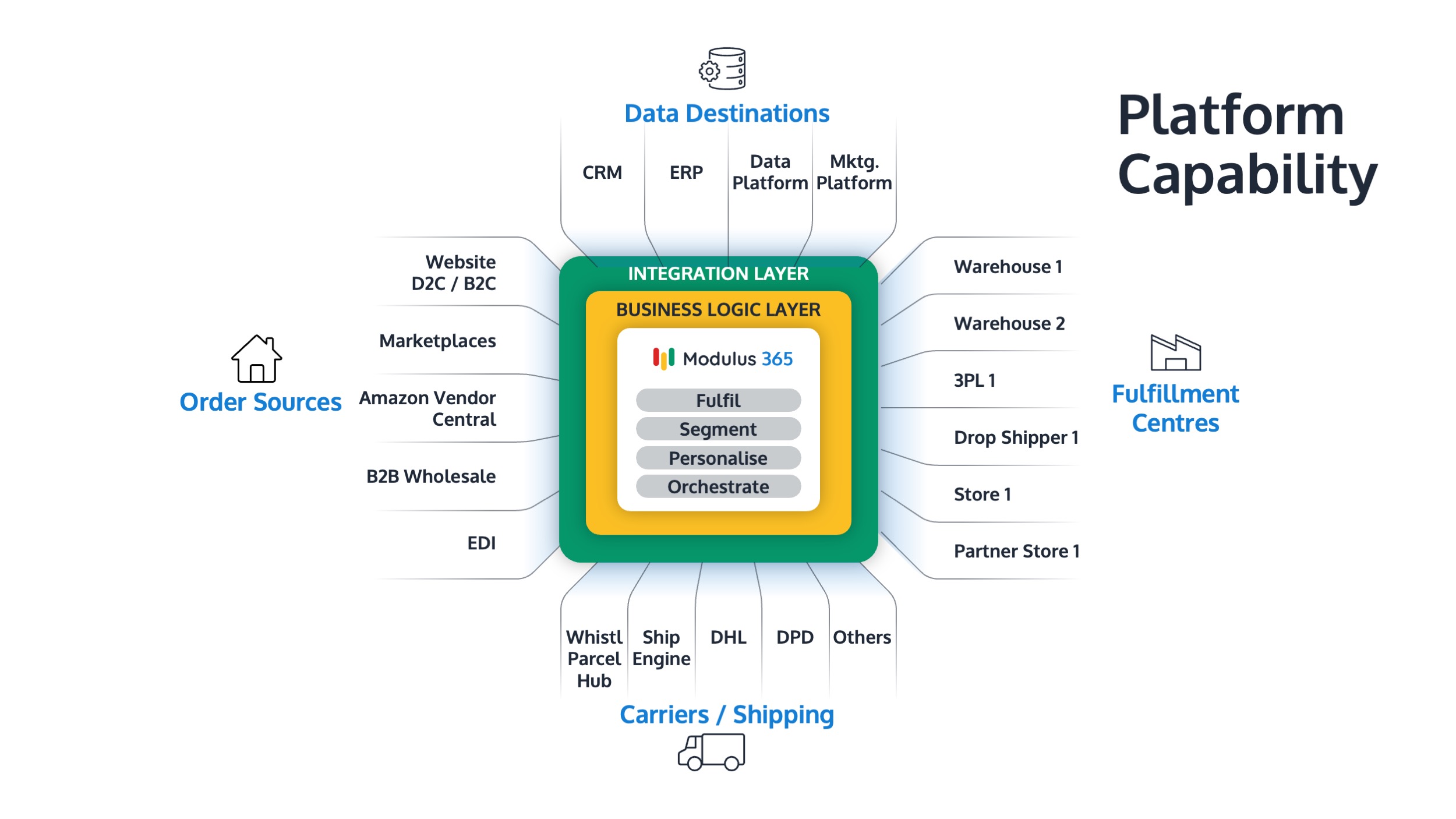
Modulus365 helps businesses connect order management, warehouse workflows, packing, carrier integration, dispatch updates, inventory visibility, and fulfilment reporting.
By helping teams apply fulfilment and carrier rules more consistently, Modulus365 supports faster dispatch, better visibility, fewer manual decisions, and stronger customer service.
For Sage businesses, Modulus365 can work alongside the ERP as the fulfilment operations layer.
👉 Learn more about Modulus365 for Sage.
Related FOA Guides
Carrier selection affects dispatch performance, delivery promise, cost-to-serve, channel SLAs, split shipments, and customer experience. These guides explain the connected areas:
- How to Improve Dispatch Performance
- What is Order Orchestration?
- How to Prioritise Orders in a Busy Warehouse
- How to Improve Packing Bench Efficiency
- Split Shipments: When to Use Them and When to Avoid Them
- Multi-Channel Fulfilment for Growing Businesses
- How to Reduce Fulfilment Cost Per Order
- Fulfilment KPIs Every Operations Leader Should Track
Ready to Improve Carrier Selection?
If carrier selection is manual, inconsistent, expensive, or causing missed delivery promises, Modulus365 can help connect order flow, warehouse status, packing, carrier labels, dispatch updates, and fulfilment reporting.
Frequently Asked Questions
What are carrier selection rules?
Carrier selection rules are the criteria used to decide which carrier and delivery service should be used for each order based on factors such as cost, destination, weight, delivery promise, customer type, and sales channel.
Why is carrier selection important in fulfilment?
Carrier selection is important because it affects delivery performance, fulfilment cost, customer experience, marketplace SLAs, tracking visibility, and customer service workload.
How should fulfilment teams choose a carrier?
Fulfilment teams should choose carriers based on delivery promise, destination, parcel weight and size, order value, customer type, sales channel, cut-off time, reliability, and total cost-to-serve.
Is the cheapest carrier always the best option?
No. The cheapest carrier may become expensive if it causes failed deliveries, late parcels, customer complaints, lost items, or replacement shipments.
Can carrier selection be automated?
Yes. Carrier selection can be automated using fulfilment rules based on order data, parcel details, destination, service level, cut-off time, and carrier performance.