

Split Shipments: When to Use Them and When to Avoid Them
Split shipments can be useful in fulfilment operations, but they can also increase cost, complexity, customer service workload, and operational risk if they are used without clear rules.
A split shipment happens when one customer order is fulfilled in more than one parcel, dispatch, warehouse, or delivery event.
This guide explains when split shipments make sense, when they should be avoided, and how fulfilment teams can control split shipment decisions more effectively.
What is a Split Shipment?
A split shipment is when a single customer order is divided into two or more separate shipments.
This may happen because products are stored in different warehouses, some items are out of stock, products require different handling, or the business chooses to dispatch available items first.
In simple terms, a split shipment answers this question: should we send part of the order now and the rest later?
Split shipment decisions are closely linked to order orchestration, because they depend on stock availability, order priority, customer promise, carrier rules, and fulfilment cost.
Why Split Shipments Matter
Split shipments affect both customer experience and operational cost.
Used well, they can help customers receive available items sooner. Used poorly, they can create confusion, extra shipping cost, unnecessary packaging, duplicated labour, and customer service queries.
Split shipments can affect:
- Fulfilment cost per order
- Carrier costs
- Packaging costs
- Warehouse workload
- Stock allocation
- Customer communication
- Returns handling
- Dispatch performance
- Customer satisfaction
For related cost guidance, read: How to Reduce Fulfilment Cost Per Order
Common Reasons for Split Shipments
Split shipments usually happen because the full order cannot or should not be fulfilled in one dispatch.
Common reasons include:
- Items are stored in different warehouses
- Some items are available and others are on back order
- One item is delayed by supplier or replenishment issues
- Products require different carrier services
- Items have different handling requirements
- Part of the order is urgent
- One item is too large or heavy to ship with the rest
- Marketplace, wholesale, or customer SLA rules require partial dispatch
- Inventory accuracy issues prevent full fulfilment
Split shipments should be controlled by rules, not left to last-minute manual decisions.
When Split Shipments Can Be Useful
Split shipments are not always bad. In some situations, they protect customer experience or operational flow.
1. When Customers Need Available Items Quickly
If a customer needs part of an order urgently, sending available items first may be the right decision.
This is especially relevant for:
- Replacement orders
- B2B operational supplies
- Urgent customer service cases
- High-priority customers
- Orders with long lead-time items
In these cases, delaying the whole order may create more frustration than splitting the shipment.
2. When Products Are Stored in Different Locations
If stock is spread across multiple warehouses, stores, 3PLs, or fulfilment locations, a split shipment may allow the order to be fulfilled faster.
However, multi-location fulfilment needs clear cost and service rules.
Before splitting across locations, consider:
- Extra carrier cost
- Delivery promise
- Customer expectation
- Stock availability
- Warehouse workload
- Whether consolidation is possible
For stock visibility guidance, read: Available Stock vs Physical Stock vs Allocated Stock
3. When Items Require Different Delivery Services
Some products cannot travel together because of size, weight, fragility, temperature, value, or carrier restrictions.
Examples include:
- Heavy and lightweight items
- Fragile items
- High-value goods requiring signed delivery
- Oversized products
- Temperature-sensitive goods
- Products requiring specialist delivery
In these cases, split shipments may be operationally necessary.
Related guide: Carrier Selection Rules for Fulfilment Teams
4. When Back Orders Need Controlled Partial Dispatch
If an order contains available and unavailable items, the business may choose to part-ship available items and send the rest later.
This can improve customer experience, but only if back order rules are clear.
Back order rules should define:
- Which products can be part-shipped
- Which customers qualify for split fulfilment
- Whether the customer should approve partial dispatch
- Who pays additional shipping cost
- How the remaining order will be tracked
- When the rest of the order should be cancelled or refunded
Without clear rules, partial dispatch can create confusion and customer service workload.
When Split Shipments Should Be Avoided
Split shipments should be avoided when they create more operational cost or customer confusion than value.
1. When the Full Order Can Ship Soon
If the missing item will be available shortly, it may be better to hold the order and ship everything together.
This avoids extra shipping cost, packaging, customer communication, and tracking complexity.
2. When Shipping Cost Outweighs Customer Benefit
Splitting a low-value order into multiple shipments can destroy margin.
Before splitting, consider:
- Additional carrier cost
- Extra packaging cost
- Additional labour
- Customer service impact
- Return risk
- Margin on the order
If the customer benefit is small and the cost is high, avoid splitting where possible.
3. When Customer Communication Is Weak
Split shipments can confuse customers if communication is poor.
Customers may wonder:
- Why did only part of my order arrive?
- Where is the rest of the order?
- Will I receive another tracking number?
- Have I been charged twice for delivery?
- Is something missing?
If your systems cannot communicate split shipments clearly, use them carefully.
4. When Inventory Accuracy Is Poor
Split shipments can become chaotic when stock records are unreliable.
If the system cannot confidently show what stock is available, allocated, picked, packed, or delayed, split shipment decisions may create further errors.
For stock control guidance, read: Inventory Accuracy: Why It Breaks and How to Fix It
Split Shipments vs Holding the Order
One of the most important decisions is whether to split the shipment or hold the order until everything is available.
| Option | Best When | Main Risk |
|---|---|---|
| Split shipment | Customer needs available items quickly or items must ship separately | Higher fulfilment cost and more communication complexity |
| Hold order | Missing item will arrive soon and customer promise allows waiting | Delayed dispatch and possible customer frustration |
The right choice depends on customer promise, stock availability, order value, margin, carrier cost, and service risk.
How Split Shipments Affect Fulfilment Cost
Split shipments usually increase fulfilment cost per order.
They may add:
- Extra picking activity
- Extra packing activity
- Additional packaging
- Multiple carrier labels
- Additional shipping cost
- More tracking updates
- More customer service queries
- More returns complexity
Because of this, split shipments should be used deliberately, not automatically.
How Split Shipments Affect Customer Experience
Split shipments can improve or damage customer experience depending on how they are managed.
They can improve experience when:
- Customers receive urgent items sooner
- Communication is clear
- Tracking is provided for each shipment
- Remaining items have a clear expected date
- No unexpected extra charges appear
They can damage experience when:
- Customers are not told the order is split
- Only one tracking number is provided
- The remaining items have no clear status
- Part of the order appears missing
- Customer service teams cannot explain what happened
Customer communication is therefore essential.
Split Shipment Rules to Define
Fulfilment teams should define split shipment rules before pressure builds.
Useful rules include:
- Which order types can be split
- Which channels allow split shipments
- Which customers require approval before splitting
- Minimum order value for split shipment
- Maximum additional shipping cost allowed
- Whether back orders can be part-shipped
- How split shipments affect delivery promises
- How tracking is communicated
- Who approves exception cases
These rules should be understood by operations, customer service, ecommerce, and finance teams.
Split Shipments and Order Prioritisation
Split shipment decisions often appear when some parts of an order are ready and others are blocked.
Order prioritisation rules should decide whether to:
- Ship available items now
- Hold the order for missing items
- Split by warehouse
- Split by carrier service
- Prioritise urgent items
- Move blocked lines into exception workflow
Related guide: How to Prioritise Orders in a Busy Warehouse
Split Shipments and Backlog Management
Split shipments can either reduce backlog or make it worse.
They may reduce backlog when available order lines can be cleared quickly. But they may also create more complexity if the remaining lines are not managed properly.
Backlog views should show:
- Orders partially shipped
- Remaining lines outstanding
- Reason for delay
- Expected stock date
- Customer communication status
- Next action required
Related guide: Backlog Management: How to Recover Without Panic
Split Shipments and Multi-Warehouse Fulfilment
Split shipments are common in multi-warehouse fulfilment because stock may be available in more than one location.
Before splitting across warehouses, consider:
- Can one warehouse fulfil the full order?
- Would splitting reduce delivery time?
- Would splitting increase cost too much?
- Will the customer receive multiple parcels on different days?
- Can customer service see both shipments?
- Can tracking be communicated clearly?
Multi-warehouse split shipments need strong stock visibility and order orchestration.
Split Shipments and Peak Season
During peak season, split shipment decisions can become more frequent because stock moves quickly and customer expectations are high.
Before peak, review:
- Back order rules
- Stock availability rules
- Carrier capacity
- Customer communication templates
- Split shipment cost thresholds
- Exception approval process
- Marketplace and channel rules
Related guide: How to Manage Peak Season Fulfilment
Split Shipment Decision Framework
| Question | Why It Matters |
|---|---|
| Is the full order available? | If yes, splitting may be unnecessary |
| Is part of the order urgent? | Urgency may justify splitting |
| Will the missing item arrive soon? | Holding may be better if delay is short |
| What is the extra shipping cost? | Splitting can damage margin |
| Can the customer be informed clearly? | Poor communication creates complaints |
| Are different carriers needed? | Product handling may require splitting |
| Does the channel allow partial fulfilment? | Marketplace or wholesale rules may apply |
| Can the remaining lines be tracked? | Outstanding work must stay visible |
Split Shipment Best Practices
- Use split shipments only when they improve service or are operationally necessary
- Define split shipment rules by channel, customer, order value, and stock status
- Avoid splitting low-margin orders unless customer impact justifies it
- Communicate clearly when an order is split
- Provide tracking for each shipment
- Keep outstanding order lines visible
- Separate exception orders from normal fulfilment flow
- Review split shipment cost regularly
- Track split shipment reasons
- Use stock accuracy and order orchestration to reduce unnecessary splits
Split Shipment KPIs
Split shipments should be measured so operations teams understand their impact.
Useful KPIs include:
- Percentage of orders split
- Split shipments by reason code
- Additional carrier cost from split shipments
- Orders partially shipped but not completed
- Customer complaints linked to split shipments
- Split shipments by channel
- Split shipments by warehouse
- Split shipments caused by stock inaccuracies
These should be reviewed alongside wider fulfilment KPIs.
How Technology Helps Manage Split Shipments
Technology helps split shipment decisions by connecting stock availability, order status, warehouse location, carrier rules, customer promise, and fulfilment cost.
A fulfilment platform can support:
- Available stock visibility
- Multi-warehouse order routing
- Order split rules
- Back order visibility
- Partial fulfilment tracking
- Customer communication triggers
- Carrier label generation for each shipment
- Outstanding line visibility
- Split shipment reporting
To understand how OMS and WMS systems support fulfilment flow, read: OMS vs WMS: What’s the Difference?
How Modulus365 Helps Manage Split Shipments
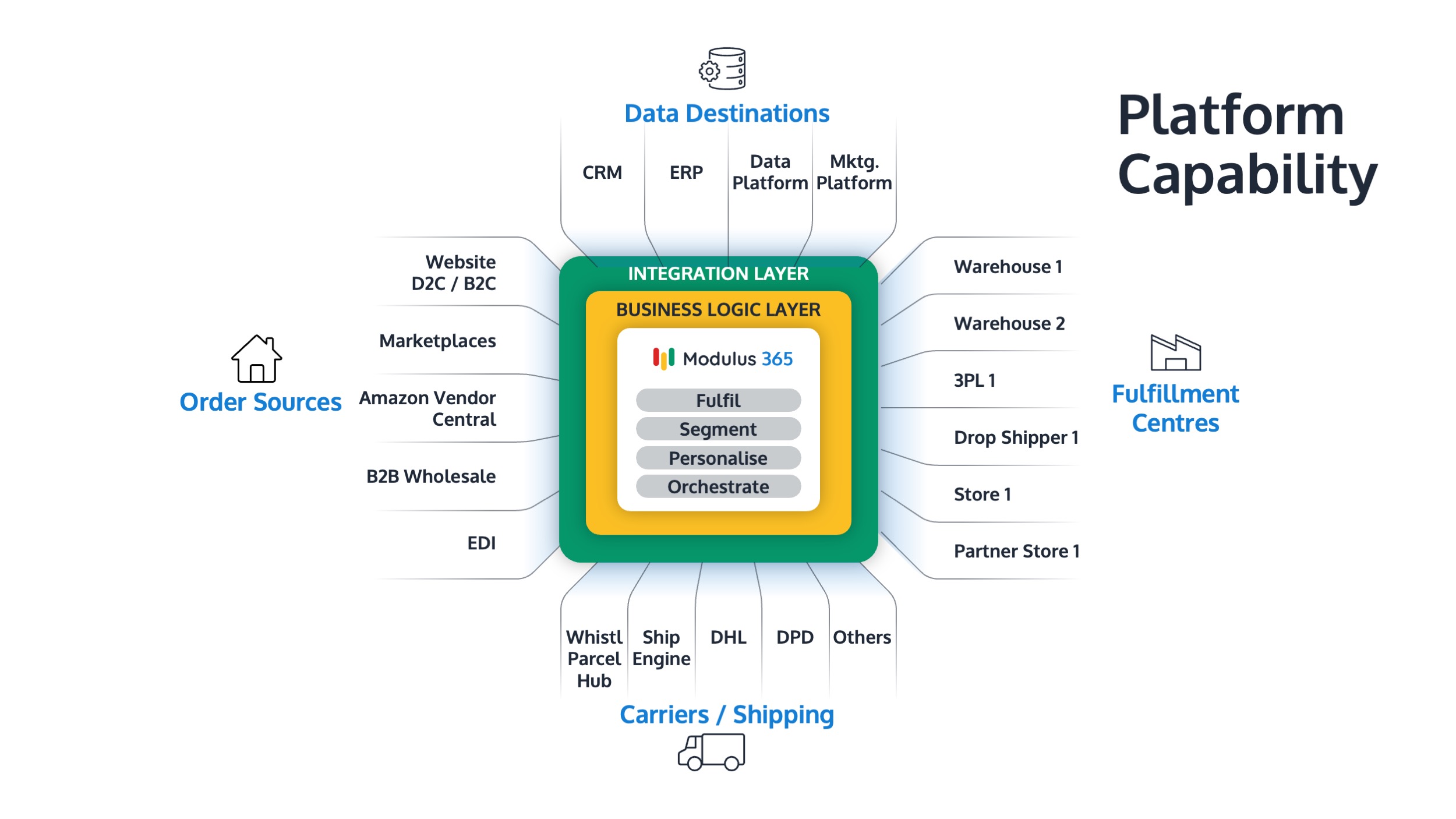
Modulus365 helps businesses connect order orchestration, inventory visibility, warehouse workflows, carrier integrations, split shipment handling, dispatch updates, and fulfilment reporting.
By giving teams better visibility of available stock, fulfilment locations, outstanding order lines, and dispatch status, Modulus365 helps businesses decide when split shipments make sense and when they should be avoided.
For Sage businesses, Modulus365 can work alongside the ERP as the fulfilment operations layer.
👉 Learn more about Modulus365 for Sage.
Related FOA Guides
Split shipment decisions depend on order orchestration, available stock, carrier rules, backlog, dispatch performance, customer communication, and fulfilment cost. These guides explain the wider picture:
- What is Order Orchestration?
- Available Stock vs Physical Stock vs Allocated Stock
- How to Prioritise Orders in a Busy Warehouse
- Backlog Management: How to Recover Without Panic
- Carrier Selection Rules for Fulfilment Teams
- How to Improve Dispatch Performance
- Multi-Channel Fulfilment for Growing Businesses
- How to Reduce Fulfilment Cost Per Order
Ready to Control Split Shipments?
If split shipments are increasing costs, confusing customers, or creating operational complexity, Modulus365 can help connect order flow, stock visibility, warehouse execution, carrier rules, and dispatch updates into one controlled fulfilment process.
Frequently Asked Questions
What is a split shipment?
A split shipment is when a single customer order is fulfilled in two or more separate parcels, dispatches, warehouses, or delivery events.
Why do split shipments happen?
Split shipments happen when products are stored in different locations, some items are out of stock, products need different carriers, or part of the order needs to be sent before the rest.
Are split shipments bad?
Split shipments are not always bad. They can improve customer experience when urgent items are sent sooner, but they can also increase fulfilment cost and complexity if used without clear rules.
When should split shipments be avoided?
Split shipments should be avoided when the full order can ship soon, the extra shipping cost outweighs the benefit, customer communication is weak, or stock accuracy is unreliable.
How can businesses control split shipments?
Businesses can control split shipments by defining rules for stock availability, order value, customer priority, delivery promise, carrier cost, back orders, customer communication, and exception handling.