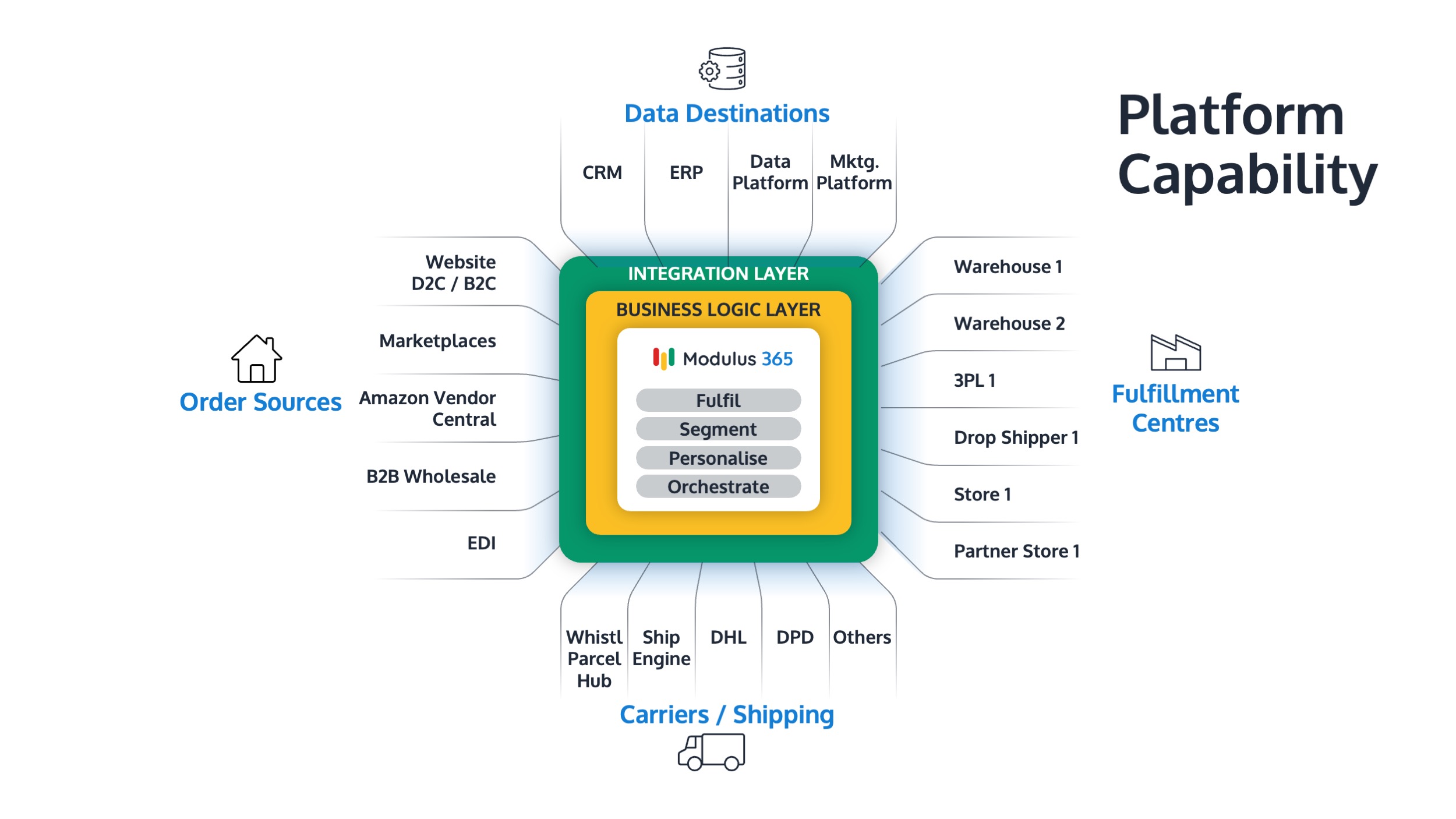


Multi-Channel Fulfilment for Growing Businesses
Multi-channel fulfilment is the process of managing orders, stock, warehouse activity, dispatch, and customer updates across more than one sales channel.
As businesses grow, orders may come from ecommerce websites, marketplaces, wholesale customers, B2B portals, retail stores, customer service teams, and EDI channels. Without the right fulfilment process, multi-channel selling can quickly create stock issues, delayed orders, overselling, warehouse pressure, and customer service problems.
This guide explains how multi-channel fulfilment works, why it becomes complex, and how growing businesses can manage order flow, stock visibility, warehouse execution, carriers, and customer promises more effectively.
What is Multi-Channel Fulfilment?
Multi-channel fulfilment means fulfilling orders that come from several different sales channels through one or more warehouses, stores, 3PLs, suppliers, or fulfilment locations.
Common sales channels include:
- Ecommerce websites
- Marketplaces
- Wholesale orders
- B2B portals
- EDI orders
- Retail stores
- Subscription orders
- Customer service or telesales orders
In simple terms, multi-channel fulfilment answers this question: how do we fulfil orders accurately and efficiently when demand comes from multiple places?
Multi-channel fulfilment is part of wider fulfilment operations.
Why Multi-Channel Fulfilment Becomes Complex
Multi-channel fulfilment becomes complex because each channel may have different order formats, customer promises, stock rules, delivery expectations, return policies, and service levels.
For example:
- Marketplace orders may have strict dispatch SLAs
- Wholesale orders may require larger quantities and specific delivery windows
- B2B portal customers may have agreed pricing and account-level rules
- Ecommerce orders may need fast parcel dispatch
- EDI orders may require specific documentation or fulfilment processes
- Retail orders may involve store replenishment or click-and-collect flows
If these channels are not connected into one controlled fulfilment process, teams may end up relying on manual workarounds and disconnected systems.
Common Multi-Channel Fulfilment Problems
Growing businesses often experience similar problems when order channels expand faster than fulfilment processes.
- Orders are spread across multiple systems
- Stock availability is not trusted
- Sales channels oversell shared stock
- Warehouse teams receive unclear priorities
- Customer service teams cannot see order status
- Manual order rekeying increases
- Split shipments become more common
- Carrier selection becomes inconsistent
- Returns are handled differently by channel
- Fulfilment KPIs are difficult to measure
These issues are usually not caused by one sales channel. They happen because the fulfilment operation has not been designed to handle multi-channel complexity.
1. Centralise Order Visibility
The first challenge in multi-channel fulfilment is seeing all orders clearly.
If orders sit separately in ecommerce platforms, marketplaces, ERP systems, spreadsheets, email inboxes, EDI portals, and customer service tools, operations teams lose control.
Centralised order visibility helps teams understand:
- Which orders need fulfilment
- Which channel each order came from
- Which orders are urgent
- Which orders are blocked
- Which orders are awaiting stock
- Which orders are picked, packed, dispatched, or returned
This is why many growing businesses need an OMS or fulfilment platform. Read: OMS vs WMS: What’s the Difference?
2. Use Available Stock, Not Physical Stock
Multi-channel fulfilment depends on accurate available stock.
If several channels sell from the same stock pool, the business needs to know what stock can actually be sold or allocated.
Physical stock is what exists in the warehouse. Available stock is what can still be promised after allocated, damaged, reserved, quarantined, or unavailable stock has been removed.
For a deeper explanation, read: Available Stock vs Physical Stock vs Allocated Stock
3. Prevent Overselling Across Channels
Overselling is one of the biggest risks in multi-channel fulfilment.
It happens when the business accepts more orders than it can fulfil from available stock.
This often happens when:
- Stock updates are delayed between systems
- Channels use physical stock instead of available stock
- Allocated stock is not deducted quickly enough
- Returned stock is added back before inspection
- Multiple channels sell from the same stock pool
- Stock buffers are not used for high-risk products
To reduce risk, read: How to Prevent Overselling Across Sales Channels
4. Define Channel-Level Fulfilment Rules
Not every channel should be fulfilled in exactly the same way.
Different channels may need different rules for order priority, stock allocation, dispatch timing, packaging, carrier selection, and returns.
Channel-level rules may include:
- Marketplace orders prioritised before SLA cut-off
- Wholesale orders released as planned waves
- B2B portal customers given account-level delivery rules
- Replacement orders prioritised above standard orders
- International orders routed through specific carriers
- Key accounts protected with reserved stock
- Low-margin channels restricted from split shipments
These rules should be clear, documented, and understood by operations and customer service teams.
5. Use Order Orchestration
Order orchestration is the decision-making layer that determines how each order should be fulfilled.
In multi-channel fulfilment, order orchestration may decide:
- Which warehouse should fulfil the order
- Which stock should be allocated
- Whether an order should be split or held
- Which carrier should be used
- Which orders should be prioritised
- Which orders should move into exception workflow
Without orchestration, teams often make fulfilment decisions manually, which can become inconsistent and difficult to scale.
Related guide: What is Order Orchestration?
6. Prioritise Orders Clearly
When orders come from multiple channels, warehouse teams need clear priorities.
Otherwise, staff may process easier orders first while urgent or SLA-critical orders fall behind.
Useful prioritisation rules include:
- Carrier cut-off time
- Delivery promise
- Sales channel
- Order age
- Customer type
- Stock availability
- Order complexity
- Marketplace or retailer SLA risk
For practical guidance, read: How to Prioritise Orders in a Busy Warehouse
7. Control Split Shipments
Split shipments can become more common in multi-channel fulfilment, especially when stock is spread across warehouses, stores, 3PLs, or suppliers.
Split shipments can help customers receive available items sooner, but they can also increase fulfilment cost, packaging cost, carrier cost, and customer communication complexity.
Multi-channel businesses should define rules for:
- When an order can be split
- Which channels allow partial fulfilment
- Which customers require approval before splitting
- How remaining order lines are tracked
- How customers receive tracking updates
- Who pays additional shipping cost
Related guide: Split Shipments: When to Use Them and When to Avoid Them
8. Choose Carriers by Rule, Not Habit
Carrier selection becomes harder when orders come from multiple channels and have different delivery promises.
A marketplace next-day order, wholesale pallet order, international ecommerce order, and B2B replacement order may all need different carrier services.
Carrier rules should consider:
- Delivery promise
- Destination
- Parcel weight and size
- Order value
- Sales channel
- Customer type
- Carrier cut-off
- Carrier reliability
- Total cost-to-serve
Related guide: Carrier Selection Rules for Fulfilment Teams
9. Improve Dispatch Visibility
Multi-channel fulfilment fails when teams cannot see which orders are close to missing dispatch.
Operations teams should track:
- Orders waiting to pick
- Orders picked but not packed
- Orders packed but not dispatched
- Orders close to carrier cut-off
- Orders stuck in exception queues
- Orders awaiting stock
- Orders delayed by channel-specific rules
This helps prevent dispatch issues before they become customer service problems.
Related guide: How to Improve Dispatch Performance
10. Keep Returns Connected to the Original Channel
Returns can be more complex in multi-channel fulfilment because each channel may have different return policies, refund rules, reason codes, and customer communication requirements.
A good returns process should link each returned item to:
- Original order
- Original sales channel
- Customer account
- Return reason
- Inspection result
- Refund, replacement, or exchange decision
- Stock status
Returns should not be processed as a disconnected warehouse task. They affect inventory, customer service, refunds, and operational reporting.
Related guide: Returns Management Best Practices
11. Use Digital Workflows Instead of Paper
Paper-based workflows become risky when multiple channels are involved.
Printed pick lists, manual order notes, spreadsheets, handwritten stock movements, and manual dispatch updates can quickly fall out of sync.
Digital workflows help teams manage:
- Order import
- Stock allocation
- Picking tasks
- Packing checks
- Carrier labels
- Dispatch updates
- Returns processing
- Fulfilment reporting
Related guide: Paper-Based vs Digital Warehouse Processes
12. Track Multi-Channel Fulfilment KPIs
Multi-channel fulfilment should be measured by channel as well as across the whole business.
Useful KPIs include:
- Orders by channel
- On-time dispatch by channel
- Order accuracy by channel
- Backlog by channel
- Returns rate by channel
- Fulfilment cost per order by channel
- Split shipment rate by channel
- Carrier performance by channel
- Stockout or overselling incidents by channel
This helps operations leaders see which channels create the most cost, risk, workload, or customer service pressure.
Related guide: Fulfilment KPIs Every Operations Leader Should Track
Multi-Channel Fulfilment Example
A growing business may receive orders from several channels during the same day:
| Channel | Fulfilment Need | Operational Risk |
|---|---|---|
| Ecommerce website | Fast parcel fulfilment | Customer delivery promise |
| Marketplace | SLA-driven dispatch and tracking | Marketplace performance penalties |
| Wholesale | Larger order quantities and planned dispatch | Stock allocation and workload planning |
| B2B portal | Account-specific pricing and delivery rules | Customer-specific service expectations |
| EDI orders | Structured fulfilment and documentation | Compliance and process accuracy |
The fulfilment operation needs to manage these channels together without losing control of stock, priority, warehouse flow, or dispatch visibility.
Multi-Channel Fulfilment Checklist
| Area | Question to Ask |
|---|---|
| Order visibility | Can we see all orders across all channels in one operational view? |
| Stock availability | Are channels selling from accurate available stock? |
| Allocation | Is stock reserved when orders are accepted? |
| Priority | Are orders prioritised by SLA, cut-off, channel, age, and customer type? |
| Split shipments | Do we have clear rules for when orders can be split? |
| Carrier rules | Are carrier choices based on service, cost, destination, and channel needs? |
| Returns | Are returns linked back to the original order and sales channel? |
| Reporting | Can we measure fulfilment performance by channel? |
How Technology Supports Multi-Channel Fulfilment
Technology helps multi-channel fulfilment by connecting orders, stock, warehouse workflows, carrier services, returns, and reporting into a controlled operational flow.
A fulfilment platform can support:
- Multi-channel order capture
- Available stock visibility
- Stock allocation rules
- Order orchestration
- Warehouse picking and packing workflows
- Carrier selection and label generation
- Split shipment handling
- Returns workflows
- Channel-level reporting
- Customer service visibility
Technology matters most when it reduces manual work and gives teams a clear view of what is happening across all channels.
How Modulus365 Helps with Multi-Channel Fulfilment
Modulus365 helps businesses connect multi-channel order management, warehouse workflows, inventory visibility, carrier integration, split shipment handling, returns processes, and fulfilment reporting.
For Sage businesses, Modulus365 can work alongside the ERP as the fulfilment operations layer, helping teams control orders from ecommerce, marketplaces, wholesale, B2B portals, EDI channels, and other sales routes without relying on disconnected manual processes.
👉 Learn more about Modulus365 for Sage.
Related FOA Guides
Multi-channel fulfilment connects order management, stock visibility, warehouse workflows, carriers, split shipments, returns, and fulfilment reporting. These related guides explain each part of the operating model:
- What is Fulfilment Operations?
- OMS vs WMS: What’s the Difference?
- What is Order Orchestration?
- How to Prevent Overselling Across Sales Channels
- Available Stock vs Physical Stock vs Allocated Stock
- How to Prioritise Orders in a Busy Warehouse
- Split Shipments: When to Use Them and When to Avoid Them
- Carrier Selection Rules for Fulfilment Teams
- How to Improve Dispatch Performance
- Paper-Based vs Digital Warehouse Processes
Ready to Improve Multi-Channel Fulfilment?
If orders, stock, channels, warehouses, carriers, and customer promises are becoming harder to manage, Modulus365 can help bring multi-channel fulfilment into one connected operational platform.
Frequently Asked Questions
What is multi-channel fulfilment?
Multi-channel fulfilment is the process of managing orders, stock, warehouse activity, dispatch, and customer updates across more than one sales channel.
Why is multi-channel fulfilment difficult?
Multi-channel fulfilment is difficult because each channel may have different stock rules, order formats, customer promises, delivery expectations, return policies, and service levels.
How can businesses improve multi-channel fulfilment?
Businesses can improve multi-channel fulfilment by centralising order visibility, using available stock, defining channel-level rules, improving order orchestration, preventing overselling, and connecting warehouse and carrier workflows.
How does multi-channel fulfilment affect stock accuracy?
Multi-channel fulfilment affects stock accuracy because multiple channels may sell from the same stock pool. Without accurate allocation and stock updates, overselling and failed picks become more likely.
What software supports multi-channel fulfilment?
Multi-channel fulfilment is usually supported by OMS, WMS, ERP, carrier systems, ecommerce integrations, marketplace integrations, and fulfilment platforms that connect these workflows together.